Showing posts with label wildfires. Show all posts

2014-09-16

Seasonality of wildfires in Iceland

In the next volume of Náttúrufræðingsins, 84(1-2): 19-26, there is an article about the seasonality of wildfires in Iceland.

Summary. Data on wildfires was collected from news databases, and for the period 2003–2010 we had data from the Iceland Construction Authority, which contains the activity of all fire departments in Iceland. Most of the fires are small; however, there were ten wildfires larger than 1 hectare in the period 2007–2013, including six larger than 10
hectares. Most of the fires are due to ignition, deliberate or accidental. There is a clear seasonal signal in the occurrence of wildfires in Iceland using data from 1943–2012. Most often they occur in spring, with 29% of each year wildfires occurring in May, followed by 28% in April and 13% in March. There is also a clear New Year’s Eve signal in January (6% of the wildfires). The data is not detailed enough to allow estimation of changes in frequency or occurrence between months, since prior to 2002/3 there was no centralized registration of wildfires. However, one can infer that wildfire during the summer months is a relatively recent development. This fits well with increased biomass
due to global warming, denser summerhouse populations, and less grazing. This also exemplifies the need for action in developing risk assessments and including wildfires in
planning.

image

The distribution of wildfires each month for the period 1943–2000 (blue columns; 161 events) and 2001–2012 (red columns; 947 events), and standard deviation.

2013-04-11

Particulate matter, dust storm and possibly a wildfire

There were many things occurring on Wednesday 10 April 2013.

PM10 was over the health limit in Reykjavik, small dust storm in the south, and possibly also a wildfire. Let’s take a closer look Bros

PM10 was over the limit in Reykjavik, at the station Grensás.

image

The 24-h average was ~58.6 µg/m3, but the health limit is 50 µg/m3. Wind speed was less than 5 m/s and, even though NOx isn’t very high, this is most likely connected to traffic.

It was possible to detect a small dust storm, most likely, on a MODIS image, Terra satellite.

20130410_modis_worldview_crop
(Image courtesy of NASA/Rapidfire)

Then there was a satellite detection of a thermal anomaly, a wildfire. These can be false, and I haven’t seen anything in the news to verify this – if you know whether there was a fire or not, please let me know. This was around 14:00 on 10 April 2013, the location is shown on the figure below.

image
Map from ja.is.

On a satellite image, taken at 14:00, it is possible to detect what might be smoke from a wildfire ?

image
Image courtesy of NASA/Rapidfire.

2012-07-10

Wildfire at Snæfellsnes

The wildfire yesterday at Snæfellsnes is seen on a satellite image (MODIS image from NASA) at 21:15 on 9 July 2012. The location is to the east on the southern part of the peninsula, see map below.

Sinueldur á Snæfellsnesi, 9. júlí 2012.

The weather in Stykkishólmur on Monday at 21:00 (from IMO vedur.is).
Wind: image 9 m/s, temperature: 10,6 °C, precipitation 0 mm / 1 hour, humidity: 57 % and visibility >70 km.

Which fits nicely with this being the smoke from the wildfire which is seen in the image above.

Raudkollsstadir_Snaefellsnes_LMIkort

Here is the location of Rauðkollsstaðir the closest farm to the wildfire (map from LMI.is) which also fits nicely with this being the smoke from the wildfire Smile

Here are finally couple of news (in Icelandic, but some with pictures) about the wildfire:

2011-08-14

Dust and ash storm near Mýrdalsjökull and Landeyjasandur

At Raufarfell the PM10 reached 590 micro-g/m3 just before 16:00.

The northerly wind direction blows sand from Landeyjasandur out to sea, over Vestmannaeyjar.

At Stórhöfði, Vestmannaeyjar, the wind was from the north at 21 m/s at 16:00. And between 15 and 18 m/s from the NNE between 12 and 13.

20110814_modis_A2011226_1235

Satellite image taken at 12:35 by Terra (image NASA/Rapidfire and IMO).

ThTh  Þröstur Þorsteinsson.
Environment and Natural Resources & Institute of Earth Sciences, University of Iceland, Sturlugata 7, 101 Reykjavik, Iceland.

2011-02-08

Scientific article about the wildfires in Iceland 2006

Finally our article in International Journal of Remote Sensing about the wildfires of 2006, Mýraeldana 2006, is out. This article emphasizes the use of satellite data to obtain estimates about the spread and intensity of wildfires.

Since final review, almost a year and a half has passed.

Thorsteinsson, Throstur , Magnusson, Borgthor and Gudjonsson, Gudmundur. 2011.

Large wildfire in Iceland in 2006: Size and intensity estimates from satellite data.

International Journal of Remote Sensing, 32(1): 17 — 29.

To link to this Article: DOI: 10.1080/01431160903439858

URL: http://dx.doi.org/10.1080/01431160903439858

 image

An example about the type of information it is possible to obtain from satellite data on wildfires.

2010-06-28

Advise for wildfires and PM10 pollution

Couple of web-pages, unfortunately only in Icelandic so far, about the health risks associated with different levels of PM10 pollution, and how to not start wildfires by accidents :-)

Wildfires advice (in Icelandic) here.

PM10 advice (in Icelandic) here.

2010-06-25

Vík, Heimaland and Hvolsvöllur PM10 2010-06-24

Generally good air quality on 24 June 2010. A little bit over the health limit though at Vik, but well below at Heimaland and Hvolsvöllur.

20100624PM10VikHeimalHvolsv

Satellite image from 14:30 on 24 June 2010 show that the south was quite cloudy. The (upper figure) shows where the sea ice lures just NW off Iceland. The lower image shows algae bloom west of Iceland nicely.

modis_red_P20101751430

modis_truecol_P20101751430

2010-06-22

Wildfire in Arizona

The wildfire in Arizona has been in the news lately, endangering houses in the area.

Schultz Fire North of Flagstaff, AZ

Image from 21 June 2010. NASA image courtesy Jeff Schmaltz, MODIS Rapid Response Team.

2010-06-05

Ash Friday – 4 June 2010

A lot of ash was blowing around the south-west Iceland on Friday. The ash stems from the Eyjafjallajökull eruption.

The satellite image below shows the large gray area, where as is blowing, clearly.

20100604_aska_zoom

Measurements of PM10 concentration show that the levels were very high at times in the Reykjavik area on 4 June 2010.

PM10_4jun2010_GREFHGHEH

This figure shows the measured PM10 concentration at Grensás (GRE), Fjölskyldu-og Húsdýragarðinum (FHG), and Hvaleyrarholti, Hfj (HEH) – all in the Reykjavik area. The HEH data are 10-min averages, while GRE and FHG are 30-min averages (therefore we would expect higher peaks in the 10-min data).

Measurements closer to the volcano, at Vík (Vik 10-min), Heimaland (Heimal. 10-min) and Hvolsvöllur (Hvolsv. 30-min), show that the concentration at Heimaland, between Vik and Hvolsvöllur, went very high, while the Hvolsvöllur data has too many gaps to really be able to tell, and Vík was relatively (compared to other stations that day) low. The reason for that is that the wind-direction was easterly, and not much blew into town (this time).

PM10_4jun2010_VikHeimHvol


The daily values have been high for the Vík, Heimaland and Hvolsvöllur stations all May (eruption stopped on 23 May 2010). The plot below shows this clearly.

PM10_Daily_May_4jun2010

This figure shows the daily average values at Vík (blue), Hvolsvöllur (reddish) and Heimaland (green).

At Vík there have been 5 days in this period with PM10 daily average over 200 mu-g/m3 (micro-grams per cubic meter): 8, 11, 12, 13 and 27 May.

At Heimaland there have been at least 3 (since mid-May), and at Hvolsvöllur at least 5 (since mid-May).

The highest levels have been at Heimaland, 1098 mu-g/m3 on 26 May, and 1008 on 4 June.

2010-02-08

Modeling of Particulate Matter pollution in Reykjavík

One of my projects is to model the level of particulate matter pollution in Reykjavik, near Grensásvegur.


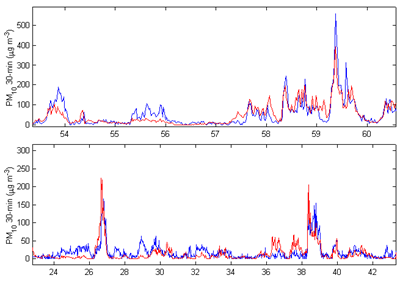
The image below is how the model has faired so far (red line is the model and blue line is the measured level of pollution). I have not included information about things like snow cover or dust storms, so some of the discrepancy may be due to that. In any case, this model is supposed to capture the pollution due to traffic and local sources.


  Overall I think it is fair to say that the model does a good job, remembering that these are 30 min values, and local disturbances (even a bus eroding settled dust) are not corrected for in any way.

2008-10-25

Líkanreikningar á svifryksmengun - hrollvekja

Á föstudaginn var hélt ég fyrirlestur við Jarðvísindastofnun þar sem ég fór yfir líkanreikninga mína á styrk svifryksmengunar. Eins og titillinn gefur til kynna er það ekkert alveg einfalt mál, en þó hefur nokkur árangur engu að síður náðst.

Eitt af því sem menn velta mest fyrir sér er þáttur nagladekkja í svifryksmengun. Samkvæmt fyrstu niðurstöðum og þær eru engan veginn endanlegar, tvöfaldast magn svifryks af völdum bílaumferðar á veturna. Það samsvarar því, ef við gerum ráð fyir að um helmingur sé á nagladekkjum (og að frost-þíða og annað hafi ekki áhrif - sem er ólíklegt) að bílar á nagladekkjum séu um 4 sinnum meiri framleiðendur á svifryki en bílar á ónelgdum.

Hafa verður í huga að engu að síður er þarna aðeins um einn þátt umferðar, malbiksslits, að ræða, sem er um55% af svifryki í toppum (skv. einni könnun), þannig að svifryk myndi í besta falli minnka beint um 20% ef engir naglar. Hér er þó ekki tekið með í reikninginn að uppsafnað svifryk gæti einnig minnkað og valdið frekari minnkun. En heldur er ekki tekið tillit til þess að frost-þíðu ferli og annað geta valdið meira sliti að vetri að þannig útskýrt aukninguna að vetri, óháð nagladekkjum.

Hér að neðan er síðan sýnishorn af líkaninu fyrir tvö tímabil á árinu 2006 (líkan er rauð lína, gögn blá lína):

image

Líkanið tekur ekki með snjóhulu og fjarlæga sandstorma eða mengunarský, en hefur hinsvegar umferð og veðurfar. Lítur bara nokkuð vel út og verður spennandi að þróa líkanið áfram.

2008-10-04

Sandstormur frá svæðinu norðan Vatnajökuls

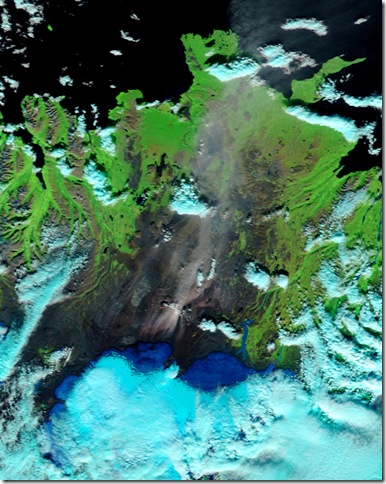
Miðvikudaginn 17. September, 2008 var stíf sunnanátt og mikill sandstrókur (jökulset) stóð frá svæðinu rétt norðan Dyngjujökuls út yfir svæðið milli Melrakkasléttu og Langaness á haf út.

Svona atburðir eru nokkuð algengir og þegar strókur sem þessi stendur frá fjörum sunnanlands inn yfir Höfuðborgarsvæðið mælist gjarnan verulega aukin svifryksmengun.

Myndirnar kom frá Jeff Schmaltz (Mynd 1), MODIS Rapid Response, NASA Goddard Space Flight Center og hinar frá MODIS Rapid Response, NASA Goddard Space Flight Center.


iceland_sandstormur_zoom

Sandstrókur frá svæðinu norðan Dyngjujökuls, áfram á milli Melrakkasléttu og Langaness á haf út.

Iceland_2008261_sandstormur_zoom

Samskonar mynd, nema núna í fölskum litum (band 721), sem sýnir jafnvel betur hvaðan fína efnið kemur.

2008-09-20

Ekki nýtt lágmark í hafísþekju / No new minimum in Sea Ice extent

image

Nú er orðið ljóst að metið frá síðasta ári verður ekki slegið. Farið er að kólna og hætt að bráðna. Á myndinni að ofan má sjá að þekjan í júlí og ágúst í ár var heldur meiri en árið 2007.

2008-06-24

Nýtt lágmark í hafísþekju í uppsiglingu ? / Sea ice - new low ?

Eftir tiltölulega kaldan vetur og þar af leiðandi meiri hafísbreiðu en veturinn þar á undan, er hafísþekjan nú þegar í maí orðin nánast jöfn því sem hún var árið áður - ísinn, sem að mestu er fyrsta árs ís, bráðnar því hraðar en árið áður, en þá náði hafísþekjan sögulegu lágmarki.

Myndin hér að neðan sýnir hafísþekjuna (minnst 15% þekja) árin 1980, 2007, meðaltalsþekju áranna 1978 - 2007 og síðan janúar til maí í ár.

After a relatively cold winter, and a greater sea ice extent than the winter before, the sea ice extent in may was nearly the same as the year before - see figure below.

seaiceextent_may2008

2008-03-19

Hafís

Síðastliðið ár mældist minnsta útbreiðsla hafíss síðan mælingar hófust.  Útbreiðslan miðar við að minnsta kosti 15% hafsvæðisins sé þakið ís.

image Eins og sjá má á myndinni að ofan, var heildarflatarmálið árið 2007 í lágmarki aðeins rétt rúmlega 4 milljón ferkílómetra.  Þetta er langtum minna en meðaltal áranna 1978 - 2007, og helmingi minna en árið 1980 þegar hæðsta gildi á lágmarks-útbreiðslu mældist.

Allar líkur eru á því að lágmarkið haldi áfram að lækka.

Ástæður þess eru:

  • Margra ára ís heldur áfram að þynnast og eyðast.
  • Enda þótt kaldir vetur myndi stóra þekju, eru sumrin oftast nægjanlega heit til að bræða megnið af þeim ís, og sennilega oftast allan þann ís og meira til.

Hafís að sumri gæti því orðið mjög lítill á næstu áratugum og jafnvel horfið alveg á þeim tímaskala.

Sinueldar á Mýrum 2006

Á Íslandi varð mesti skráði sinubruni Íslandssögunnar þegar eldur kom upp á Mýrum vorið 2006, en þar brann svæði sem var um 73 km2 að flatarmáli.

Kort af brunasvæðinu - Þröstur Þ, Borgþór M. og Guðmundur G. Til viðmiðunar má nefna að flatarmál Þingvallarvatns er um 82 km2.

Með úrvinnslu gervitunglamynda og athugunum á jörðu niðri var hægt að rekja framvindu eldanna á Mýrum.

image Nýlega kom upp eldur í mosaþembu á Miðdalsheiði í júní 2007. Þótt brunasvæðið á heiðinni væri lítið (0,09 km2) í samanburði við svæðið á Mýrum var um að ræða einhvern mesta gróðureld í nágrenni Reykjavíkur í seinni tíð.

Frekari rannsókna er þörf til að gera áhættumat vegna slíkra elda í sumarhúsabyggð.  Nauðsynlegt er að afla sem bestrar vitneskju um útbreiðsluhraða elda við þær aðstæður sem ríkja á hverju svæði og meta hvenær hætta er á slíkum eldum.

Unnið er að því að fjármagna slíkar rannsóknir.

Lesa má um Mýraelda í væntanlegum greinum eftir Þröst Þorsteinsson, Borgþór Magnússon og Guðmund Guðjónsson í Náttúrufræðingnum og International Journal of Remote Sensing - nánar síðar.

Technorati Tags: